Why large IT projects in government so often fail (and how it might be done differently)
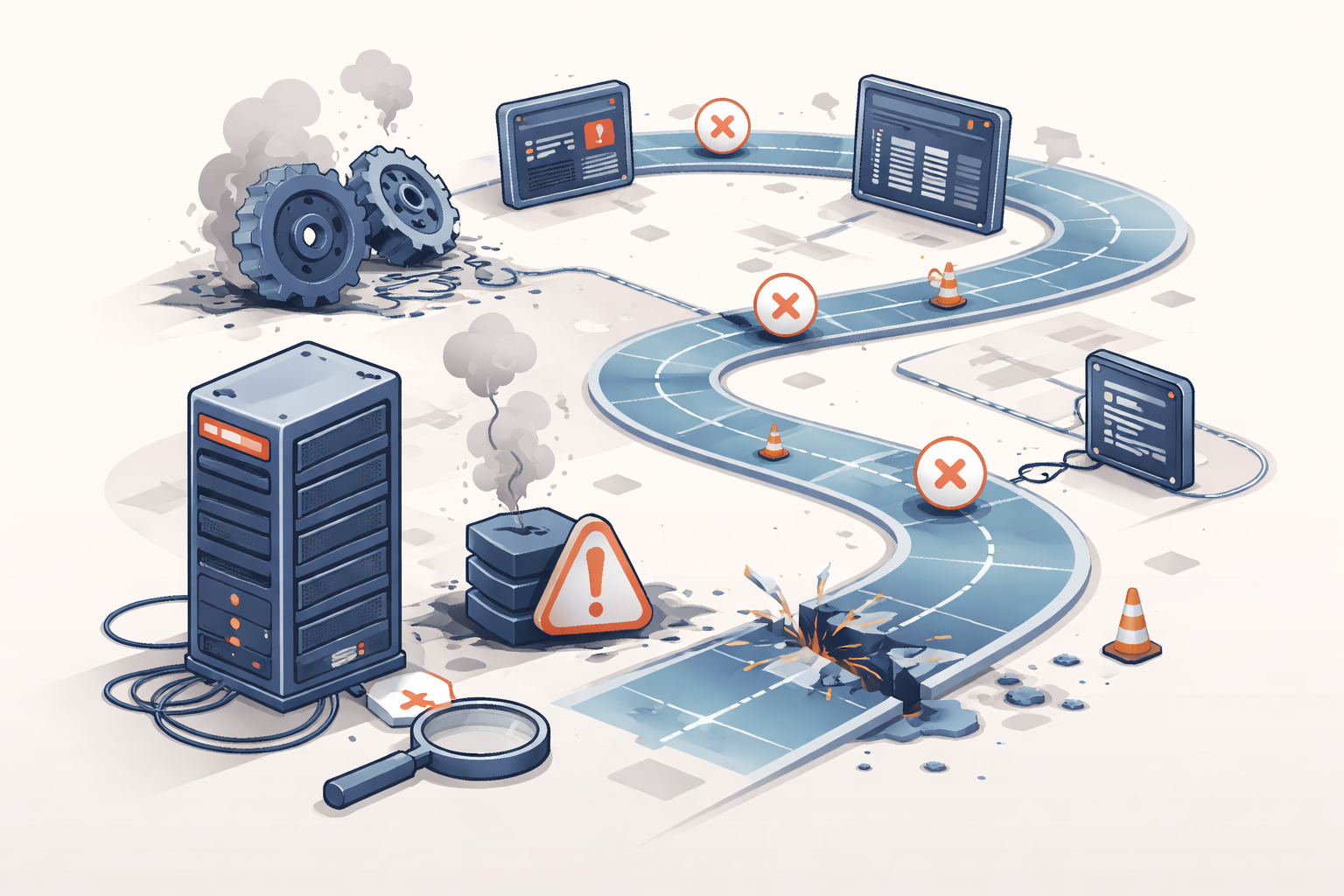
The Belgian government is once again in the news for negative technological developments. Two major failed digitalization projects in a short period demonstrate how difficult it remains to successfully complete complex IT projects within the public sector, even as the need for high-performing digital systems is greater than ever.
i-Police & Persona
After the 2016 terrorist attacks, there was a growing realization that information needed to flow faster and smarter within police forces. The i-Police project was intended to provide the solution: an innovative platform that would integrate databases and applications, make information from street cameras and social media more easily analyzable, and enable closer cooperation among police services.
In theory, it makes sense, especially for those who believe data is the holy grail and privacy is secondary. The story begins in 2017 when Smals – who else? – appointed consultants to develop the specifications. In 2021, a framework agreement worth no less than 299 million euros was concluded with a consortium led by the French consultancy group Sopra Steria. The fact that Annelies Verlinden worked as a lawyer for that IT company before she became Minister of Justice was employedis one thing, but the claim that no other party in Belgium could have handled this project equally well is a second point of contention.
Because 'equally well' can be read as 'equally poorly'. In 2023, a Deloitte report emerged that reads like one big red flag. A lack of vision, misplaced priorities, and unclear communication derailed i-Police. The project would still run for three more years before being pulled. Officially, over 75 million euros had already been paid, but in reality, the amount is likely much higher if you also include preparatory costs and the maintenance of existing systems.
According to an article in De Tijd , the cost quickly exceeds 100 million euros in taxpayer money with no tangible results. As Computer Club already pointed out: that's ten euros for every Belgian, in exchange for nothing. Fifty euros for a family with three children living in poverty, in exchange for nothing. A whole week's worth of groceries, in exchange for nothing. Bring such a family into parliament when i-Police is being discussed, and both politicians and consultants would have to account for what that money has delivered.
Things are also going wrong at the Agency for Educational Services. The Persona project was intended to modernize personnel administration and payroll processing for 220,000 teachers and nearly 4,000 schools. However, after more than five years, only 8 to 10 percent of the functionalities have been realized while the entire budget of 16 million euros was squandered. Zuhal Demir said no to the request for another ten million, and halted the IT project.
And no, these are not isolated incidents. Consider projects like Phenix and JustSign within the justice system, or Hoppin at De Lijn. The pattern is too familiar to be dismissed as mere coincidence. The only question that remains is: why do such projects seemingly succeed less often for governments than for large companies? And how do we solve that?
The Challenges
The immediate reaction is often to point fingers at technology or suppliers. However, the real causes usually run deeper, stemming from how public organizations operate and make decisions. This isn't a criticism, but it's crucial that we acknowledge it.
1. No Real Customer Pressure
When a major IT project fails in a company, it has immediate consequences: revenue drops, customers leave, and jobs are jeopardized. For the government, the impact often remains indirect. An investigation, a report, and parliamentary questions follow, and in the next legislative term, a new project simply begins. This reduces the incentive to make quick adjustments.
2. Political Cycles Clash with Long Projects
A major digitalization initiative often spans multiple legislative periods. New ministers bring new visions, which can alter the course even before the project fully matures. In companies, this strategic shift is typically less pronounced. I once witnessed this firsthand: we built a website for a government organization that was completely ready to go live. Then the product owner left. The project was shelved, and the website was never published. The fact that political cycles don't align with such extensive projects is another problem: a project can sometimes continue unnoticed for a long time because no one takes ownership.
3. The Burden of Legacy Systems
Large companies also grapple with outdated systems, but they can more often make the decisive move to start fresh. Governments have that luxury less frequently. Sometimes, legislation is literally embedded in the software. Adapting it then means not only rewriting code but also changing regulations, a process that can take years.
4. Procurement remains a structural problem
Too often, procurement still revolves around the lowest price. Or specifications are written that, consciously or unconsciously, perfectly match one specific party. Organizations then try to completely lock down a project in thousands of pages of documents. That's not even an exaggeration: the i-Police assignment was documented in 2,000 pages. But that's not how modern software development works. Digital products evolve. They require room for adjustments. By the time those two thousand pages are written and read, OpenAI is already three ChatGPT versions ahead.
5. Transparency makes experimentation difficult
Public transparency is a great asset, but it comes with a downside. Experimentation is part of innovation. Ideally, you launch ten pilot projects, knowing that perhaps only one will be truly successful. In political reality, however, the opposition is ready to mercilessly shoot down every failed experiment. The consequence? Governments more often opt for a false sense of security than for controlled risk.
Possible solutions
So there are a number of explanations we need to be aware of, but that shouldn't stop us from continuing to digitalize. I am absolutely in favor of a strong government, but it must be efficient. A cumbersome government costs a lot of money, which plays right into the hands of (extremist) parties who want to erode the power of that government.
After I brought up this topic in Computer Club, a discussion about possible solutions arose on our forum. A first category of ideas revolves around procurement and governance: according to many, the current system, which mainly focuses on the lowest price, leads to large, complex contracts that only the biggest players can bid on. Innovation and smaller players are excluded, and the chance of failure increases.
There was also criticism regarding the lack of internal expertise within governments to assess the quality delivered and to manage the project itself, and on how political priorities and terms of office make thinking and decision-making around digital projects short-sighted.
Additionally, comments were made about project setup and scale: automating without first addressing the underlying organizational chaos simply leads to “automated chaos,” as someone put it. Overly large scopes, a lack of internal management, and the absence of real decision-making power within projects ensure they are unsustainable from the outset. One of the suggested solutions is therefore to work with smaller, manageable assignments instead of trying to design a monumental system all at once. Develop an MVP, instead of trying to digitalize the entire justice system at once. Through smaller assignments and a focus on workable first versions, the government can not only better distribute risks but also deliver visible results more quickly, which can strengthen support for digitalization.
Finally, the emphasis was on building culture and capacity. Increase internal competencies in product management and technical knowledge, so that the government is not entirely dependent on external consultants and can better determine what is needed and what is delivered.
Do you have any tips or insights yourself? Then be sure to join the discussion on our forum!

.png)

.jpg)